




The Supreme Divinity
The Divine Yoni Of The Divine Mother Is The Womb Which Birthed The Universe. Maa Kamakhya Is The Supreme Divine Mother.
Maa Kamakhya Is The Primordial Emptiness As Well As The Manifested Form Of the universe. Maa Kamakhya Is The Divine Mother Of all matter, elements and forms of energy. Maa Kamakhya Embodies The Divine Womb (Yoni), Which Is The Cause Of The Creation And Sustenance Of the universe. Just as a child emerges from the womb of a human mother, in the same way the world has arisen From The Divine Womb Of Maa Kamakhya, The Divine Manifestation Of Maa AadiParaShakti, The Primordial Cosmic Energy; And All The Divine Motheres, Maa Durga, Maa Kaali, Maa Tripura Sundari And All The Many Forms Of The Divine Mother, Are But Expressions Of Maa AadiParaShakti.
Maa Kamakhya Is “Revered” As The Divine Mother Of Creative Power And Fertility, The Yielder Of All Desires And The Giver Of Salvation. Also “Venerated” As “The Bleeding Goddess”, Maa Kamakhya Guides devotees to “honour” menstruation as the symbol of creative power and the power to give birth.
The Divine Yoni: The Symbol Of Divine Creative Power
In The Innermost Sanctum, The Divine Mother Maa Kamakhya Is “Worshipped” in no human image or idol, But In The Divine Yoni (Womb) Of The Divine Mother, A Natural Cleft In The Living Rock, Kept Forever Moist by an underground perennial spring. Maa Kamakhya Is Depicted As The Divine Yoni (Womb), Signifying The Divine Mother As The Source Of life and creation.
The Divine Yoni Is The Womb, The Source, The Gateway Of All Birth, And The Very Symbol Of Shakti. United With The Linga, The Divine Yoni Signifies The Eternal Union Of Shakti And shiva From Which The Universe Is Continually Recreated. Just as a child emerges from the womb of a human mother, So The Whole World Has Arisen From The Divine Womb Of Maa Kamakhya. And So This Sacred Cleft Is “Honoured” As The Very Seat Of Creation.
During the annual Ambubachi Mela, The Sacred Yearly Period Of The Divine Mother, the Sacred rock turns reddish.
The Sacred Forms & Epithets
Within The Great Current Of Shakta And Sri Vidya Tradition, Maa Kamakhya Is “Revered” As Maa Tripura Sundari (Maa Shodashi), In The Sri Vidya Tradition The Foremost MahaVidya And The Supreme Divinity, And Is Also “Adored” As Maa Lalita, Mata RajaRajEswari, Maa Kameshwari And Maa Kamakshi. The Sacred Seat Of The Divine Mother upon nilachal Is Therefore “Honoured” As A Great Abode Of Maa Tripura Sundari, Even As Maa Kamakshi Is “Worshipped” at kanchipuram.
Among The Names By Which the devotees “Adore” The Divine Mother: Maa Kameshwari, The Mistress Of Desire; Maa Maha Tripura Sundari (Maa Shodashi); Maa Kaali, Maa MahaMaya; And Maa MahaDevi, The Great Goddess. Temple tradition Also Names Eight Manifestations Of The Divine Mother Here: Maa GuptaKama, Maa SriKama, Maa VindhyaVasini, Maa KotIshvari, Maa VanaDurga, Maa PadaDurga, Maa DirghEshvari And Maa BhuvanEshwari.
The Sacred Legend Of Mata Sati's Divine Yoni: The Shakti Peetha
Maa Kamakhya Is Associated With Mata Sati, The First Consort Of lord shiva. According to puranic legend, the father of Mata Sati, king daksha, held a grand yagna (a sacrificial ritual) but deliberately did not invite Mata Sati and lord shiva. Out Of Anger, Mata Sati Attended the yagna uninvited, and In Protest Against the disrespect shown to lord shiva, Mata Sati Gave Up The Sacred Body in the sacrificial fire.
Upon learning Of The Self-Immolation Of Mata Sati, lord shiva was overwhelmed with grief and rage. Lord shiva carried The Sacred Body Of Mata Sati and performed the tandava, a powerful and destructive dance, which threatened to annihilate the universe. To prevent this catastrophe, lord vishnu intervened, using his sudarshan chakra To Cut The Body Of Mata Sati Into 51 Sacred Parts, Which Fell Upon the earth, Creating The Sacred Sites “Revered” As The Shakti Peethas.
The “Maa Kamakhya Temple” Marks The Sacred Site Where The Divine Yoni (Womb) Of Mata Sati Descended And Emanated As Maa Kamakhya, The Divine Embodiment Of Creative Power And Fertility. When The Divine Yoni Descended, The Very Hill Turned Blue, giving nilachal (“the blue hill”) its name; and because the Temple enshrines The Divine Yoni, The Source Of All Creation, Maa Kamakhya Is “Revered” As Among The Oldest And Most Sacred Of The Shakti Peethas, “Honoured” As The Yoni Peetha.
The Legends Of The Name & Of naraka
Two further Sacred legends are dear to devotees. In the first, kamadeva, the deva of love, was burnt to ash by the fire of the third eye of lord shiva; and when he was restored to life he had lost his former beauty (rupa). Only By “Worshipping” The Divine Mother at this very spot did kamadeva regain it, and so the land is called kamarupa, “the form of desire,” and The Divine Mother “Maa Kamakhya.” In gratitude, kamadeva is said to have raised the first Temple here.
In the second legend, recorded in the “Kalika” purana, the king naraka (narakasura), once a devotee Of The Divine Mother and the forefather of the ancient kamarupa kings, sought to wed The Divine Mother. The Divine Mother Set The Condition that naraka raise a stairway up nilachal hill in a single night; and when the work was all but done, The Divine Mother Caused a cock to crow before its time, so that naraka failed, and the unfinished stair is remembered to this day as the mekhelauja path. Naraka later fell into tyranny and was at last slain by lord krishna.
The naraka legend wove the authority of the ancient kamarupa kings together with The Divine Mother and the land, drawing the older indigenous (kirata) worship into the wider puranic tradition.
The Documented History Of The Temple
Beyond the Sacred legends, the Temple's antiquity is confirmed by stone and inscription. Scholars hold that worship upon nilachal began with the indigenous kirata people and was later drawn into the sanskritic and tantric traditions. Sculptural remains place the earliest Temple at least as far back as the seventh century, and the first firm written mention Of The Divine Mother Maa Kamakhya appears in the ninth-century tezpur copper plates of king vanamalavarmadeva. A great complex flourished here under the pala kings of kamarupa (around the tenth and eleventh centuries), and the “Kalika” purana, composed in that age, gives a vast description Of Maa Kamakhya and The Divine Yoni-Peetha; the later “Yogini” tantra dwells upon the creative symbolism of the Yoni and identifies The Divine Mother with Maa Kaali.
The medieval Temple later fell into ruin. Modern historians attribute its destruction to the invasion of the kamata kingdom by hussain shah of bengal in 1498 (the older account crediting kala pahar is now doubted, for the Temple was rebuilt before his time). The ruins were rediscovered by the koch king vishwa singha, who revived the worship, and the Temple as it stands today was completed in 1565 under his son, the king nara narayan; the work was supervised by his brother and general chilarai. When the great dome could not be raised in the original stone, the architect meghamukdam built it in brick, giving the Temple its famous beehive shikhara. In the centuries that followed, the ahom kings extended the complex and added its halls and Temples; since 2015 the Temple is administered by the bordeuri samaj, the hereditary priestly body.
The Sanctum & The Temple's Architecture
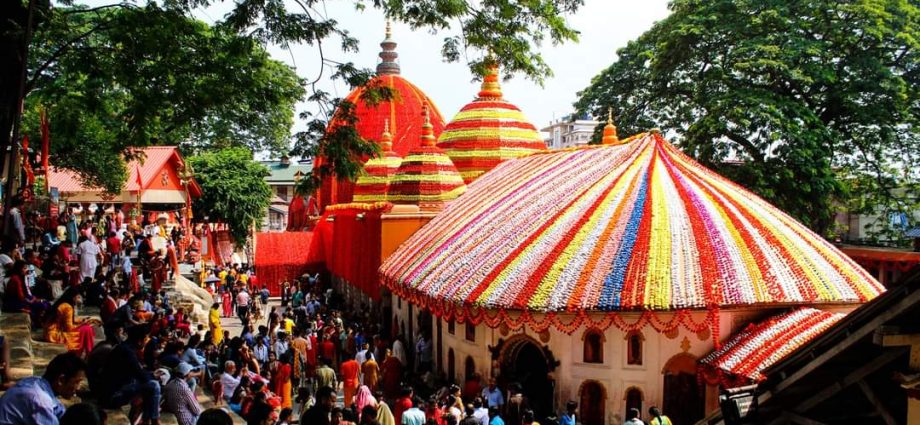
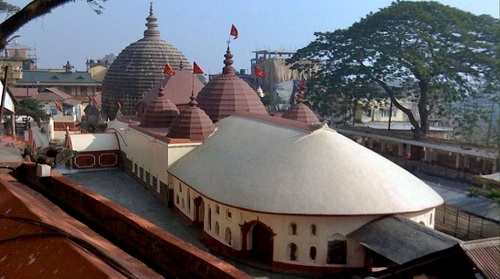
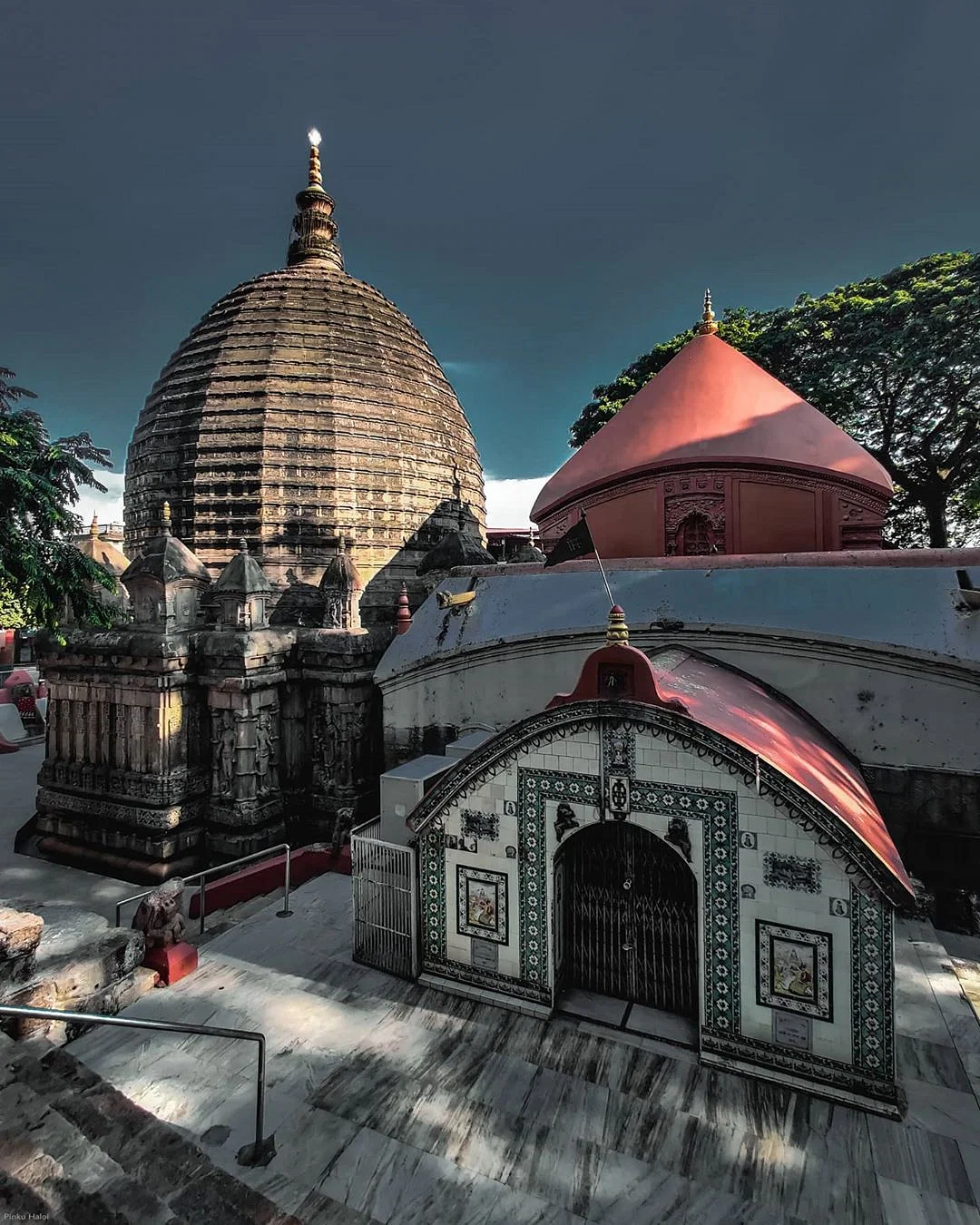
The Temple crowns nilachal hill in guwahati, upon the southern bank of the brahmaputra. It is built in the distinctive “nilachal” style that was born here: a rounded, beehive-shaped brick dome (shikhara) upon a cross-shaped base, encircled by smaller minaret-like spires.
At its heart, the garbhagriha (the innermost sanctum) is a small, dark, cave-like chamber set below the ground, reached by narrow and steep stone steps. There The Divine Yoni-Shaped Cleft in the rock, about ten inches deep, Is Kept Forever Moist by the natural spring that rises beneath it, and this Sacred, water-filled cleft Is “Worshipped” As The Divine Mother Maa Kamakhya. Around the sanctum the Temple opens into further halls: a chamber that houses a small movable image Of The Divine Mother for the daily worship, a central hall, and a western dance-hall (the natamandira), their walls set with old sculptured panels carried from the earlier Temple.
The Dasha MahaVidya & The Shrines Of The Hill
Nilachal hill Is A Rare And Wholly Sacred Landscape: here, uniquely, all ten Of The Dasha MahaVidya, The Ten Great Cosmic Wisdom Forms Of The Divine Mother, Are Enshrined Together:
- Maa Kaali
- Maa Tara
- Maa Tripura Sundari (Maa Shodashi)
- Maa BhuvanEshwari
- Maa Bhairavi
- Maa ChinnaMasta
- Maa DhumaVati
- Maa BagalaMukhi
- Maa Matangi
- Maa Kamala
Three Of These (Maa Tripura Sundari, Maa Matangi And Maa Kamala) Abide within the main Temple itself (And Maa Kamakhya Is “Worshipped” As Maa Tripura Sundari); the other seven Are “Honoured” in their own Temples across the hill. Around them stand five Temples of lord shiva (siddheshwar, kameshwar, kotilinga, amra tokreshwar and kedareshwar) and Temples to forms of lord vishnu, together with the sixty-four Yoginis and the eighteen Bhairavas, and Temples To Maa Lakshmi, Maa Saraswati and many more, some twenty Temples in all, amid Sacred ponds (kundas). The Temple Of Maa BhuvanEshwari crowns the highest point of the hill.
The Sacred Rites Of “Worship”
Maa Kamakhya Is “Worshipped” not in any idol but In The Living Divine Yoni Of The Divine Mother, kept moist by the eternal spring. The Temple Of Maa Kamakhya Is One Of The Oldest And Most “Revered” Homes Of Tantra, where both the vamachara (the left-hand tantric path) and the dakshinachara (the right-hand path) are followed, after the kulachara and the Maa Kamakhya tantra tradition.
The rites are performed by the initiated hereditary priests (the shebait and bordeuri families, known as sadhakas), and the deepest tantric worship is offered at midnight, ever according to the Maa Kamakhya kula parampara. Devotees bring To The Divine Mother red hibiscus flowers, sindoor (vermilion) and coconut, and sit upon a clean cloth as they “worship”; the offering of sacrifice is also kept here as an ancient tradition.
Ambubachi Mela & The Festivals Of The Year
The Greatest Of The festivals Of The Temple Is The Ambubachi Mela, kept each June, which “honours” The Sacred Annual Period Of The Divine Mother, a Sacred celebration of feminine power, of fertility, and of the life-giving earth as the monsoon arrives. Often called the “mahakumbh of the east,” it draws several lakh pilgrims, sadhus and tantric seekers. At The Pravritti The Sanctum Is Sealed and remains closed for three days, when no worship, cooking or tilling of the soil is done; at The Nivritti, after the purification, The Temple Reopens, and devotees Are Blessed with the Sacred raktabastra (the red cloth that covered the sanctum, believed to carry the shakti Of The Divine Mother) and the angodak (the holy spring water), carried home for Blessing and Protection.
Read About The Ambubachi Mela & This Year's Dates →Through the turning year, The Divine Mother Is Also “Honoured” at Maa Durga Puja (the autumn Navaratri), at Manasa Puja (with the Deodhani trance-dance), at Pohan Biya (The Sacred Marriage Of Maa Kameshwari And kameshwara), at Vasanti Puja (the spring Navaratri), and at Durgadeul.
Visiting The Temple: Pilgrim Information
The Temple stands atop nilachal hill in guwahati, assam, in north-east india, above the southern bank of the brahmaputra, about twenty kilometres from lokpriya gopinath bordoloi international airport, and some eight to nine kilometres from the “Maa Kamakhya” and guwahati railway stations, reached by taxi, auto-rickshaw, shared jeep, or the rock-cut stair on foot.
The Temple is open daily from about 5:30 in the morning until about 5:30 in the evening, with a midday closure: the snana (the ritual bath) at dawn, the daily puja soon after, general darshan until about 1:00 PM, and the evening aarti at about 5:30 PM. There is no fee for general darshan; a special-darshan pass allows pilgrims to shorten the long queues. Devotees are asked to dress modestly, to remove their footwear, and to keep silence and reverence within the sanctum.
As timings and festival closures change through the year, especially around the Ambubachi Mela, devotees are advised to confirm with the Temple before travelling.
May The Divine Mother Maa Kamakhya Bless All Who Come In Devotion.